
Thirty years ago, the New York Times journalist Peter Applebome wrote a book about the South. The title, Dixie Rising: How the South Is Shaping American Values, Politics, and Culture, said it all. Applebome surveyed the landscape of the mid-1990s and saw the Southerners Bill Clinton, Al Gore, Newt Gingrich, and Trent Lott occupying the commanding heights of government; he saw states below the Mason-Dixon line booming economically and demographically; he saw the old liberalism of the Northeast in flight before the conservatism of the Bible Belt; and he saw cultural products like country music and NASCAR breaking containment to go nationwide. He concluded, naturally enough, that the South had conquered America.
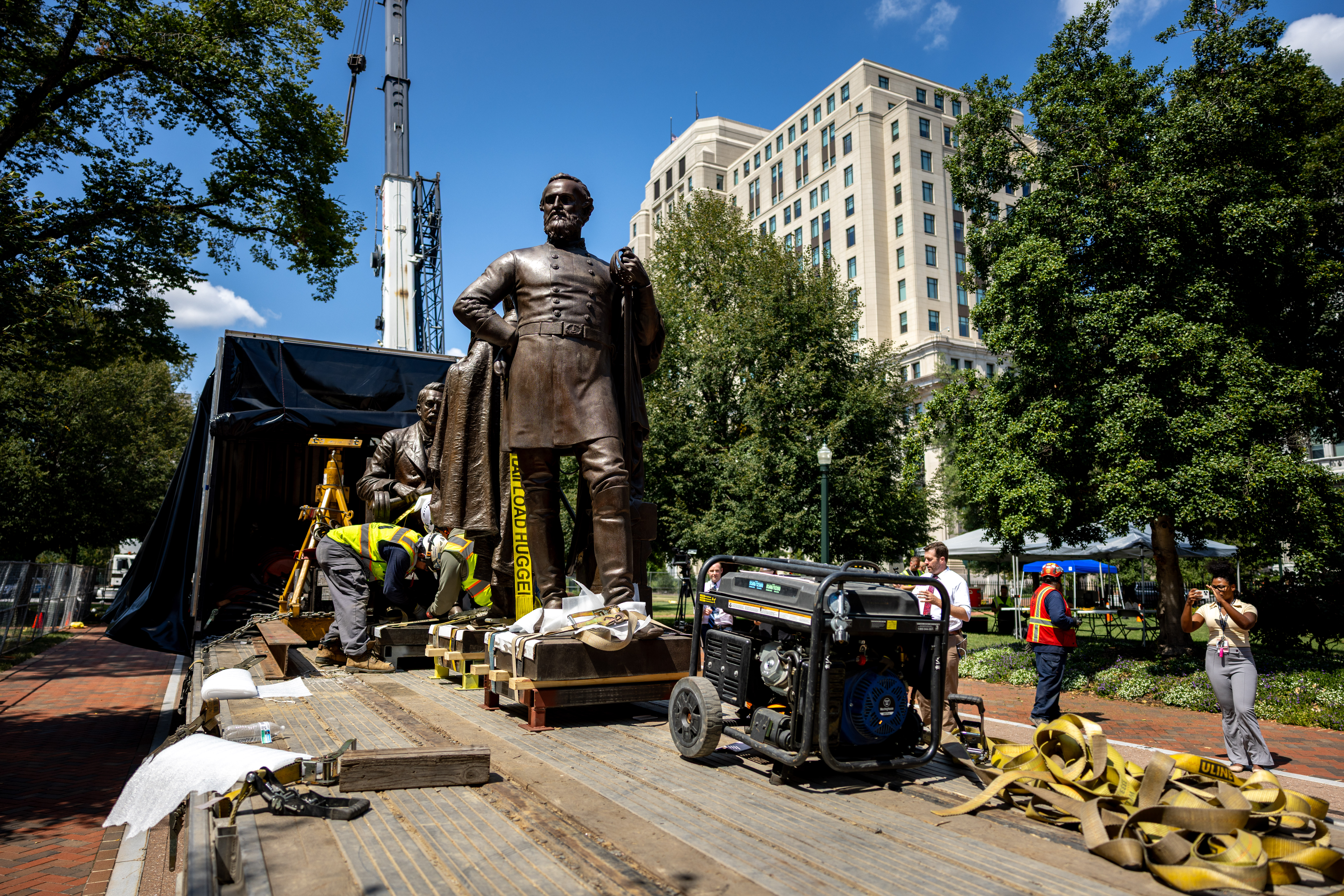
I happened to be reading this book last week, when I heard that Virginia had removed three more Confederate statues—the last, apparently, still standing on state-owned land—from Richmond’s Capitol Square. One was Stonewall Jackson; the other two were the lesser-known Hunter Holmes McGuire (a surgeon who advocated for treating wartime doctors as non-combatants) and William “Extra Billy” Smith (a general and governor, whose goofy nickname derived from an obscure antebellum episode involving postal routes).
That Applebome’s decades-old thesis might need revision was suggested by the reason this news caught me by surprise: not because there was anything peculiar about yet another enactment of the damnatio memoriae, but because there remained any graybacks still left to topple.
For the iconoclasm unleashed by 2020’s Great Awokening left no corner of the state untouched, effacing the physical traces of the Confederate States of America wherever it found them: Alexandria and Abingdon, Hampton Roads and Harrisonburg, Waynesboro and Williamsburg. Six years on, I had assumed its progress was basically complete.
There was, moreover, a certain naturalness about the phenomenon; in many ways, it constituted a logical—if unexpectedly sudden and frenetic—culmination of a trend long underway. I grew up in Northern Virginia, which for decades has been the state’s richest, most populous, and most culturally amorphous area. By the time I was old enough to form memories, accents from elsewhere were heard far more frequently than Southern twangs, and, insofar as anyone I knew considered our locality’s past, there was a hazy sense it began at some point between the Second World War and the Reagan administration. Yet if NoVa was an outlier, it was also a leading indicator: The rest of the state was moving inexorably toward the vaguely Mid-Atlantic-feeling, transplant-filled suburbs of Arlington and Fairfax.
. . . more